
BW July 21, 2010
Conversation with a lady Jinn (*) who has occupied herself inside an Omani woman:
Healer/spiritual man from Bahla: “What are you doing inside her?”
Jinn: “I like living in this body!”
Healer: “Why?”
Jinn: “I want Henna… I want gold…I want precious stones!”
Healer: “But, why trouble this woman…why are you doing this to her?”
Jinn: “I want more and if she (the body she had got into) does not give me more gold, I will make her sick – very sick!”
Healer: “You will do nothing of that sort. You will leave – I will make you leave! By God’s will, I will make you leave this body!”
The above is Moalim (healer/spiritual man) Salim bin Mubarak bin Khamis Al Ghafri’s conversation with a female jinn/jinni (a spirit) that had apparently got inside a lady. Moalim Salim was giving Black & White a hint of what he normally faces while dealing with people who claim to be possessed by jinns and the like when he gave us the above conversation extract.
Moalim Salim is a respected man in Bahla, which is home to many myths and legends of magic.
In fat, magic and mystery still surrounds this ancient walled town, which is about 30kms west of Nizwa, the road to Ibri.
Bahla is also home to another type of ‘magical’ creations – pottery. The Omani Bahla potters are known to have magic in their fingers and their creations adorn many a home both in Oman and abroad.
But, a mysterious aura surrounds the walled city because many still believe that magic is still practiced in Bahla. Before we embarked to the city, we asked many Omanis about Bahla and some of them displayed an element of superstition and declined to talk much about it. In fact, stories abound about magic in Bahla. Some of the far-fetched stories include people being bewitched and turned into animals and then enslaved.
Bahla – centre of jinn?
In fact, a recent story of a small Omani girl with recurring fits and a mysterious fire episode in her home cast a spell on us and we went to meet her and her family. We realised why Bahla is still famously known to be a centre of jinn and why many people are led to believe that these spirits still support occult traditions of black magic and alchemy. Fortunately, we did not come across any who practiced this. Instead, we met up with a traditional healer who also helped heal a small girl from the so-called clutches of a jinn.
For this, we travelled to Saiyfam village in Al Ghafat, Bahla. We were ushered into the modest home of Masoud bin Abdullah Suleiman Al Shikely, a septuagenarian, whose granddaughter was reportedly under a jinn’s influence and had frequent episodes of fits and blacking out.
But, 12-year old Huda, who was at the centre of this current jinn story, did not even show any traces of her recent trauma, and was giggling along with her young cousin brothers, as her grandfather and her uncle detailed their recent tryst -- with a semi-malevolent jinn who apparently hurled rock-like stones on their home and also partially burnt the house -- chronologically.
Seated down in the majlis of their very small and now decrepit home, Masoud Al Shikely detailed the jinn attack to their home:
June 1, 2010
My Huda is a physically active and energetic little 12-year old. She has never had any major health problems. But, on this day, she just passed out. She got into an episode of fits and she blacked out. This is the first time ever that she has fallen sick.
Maybe she was weak or ill, we thought and soon forgot about it as she quickly recovered from that episode.
But, in the next four days, Huda continued to have recurring fits and blackouts. Then we began to panic as we really did not know what to do as we did not have any prior experience in confronting such an illness. Then, someone advised us to take Huda to a Moalim (traditional healer) for a reading.
We are also more comfortable meeting with a traditional healer than approaching a modern clinic.
So, the Moalim read for Huda from a bowl of water and a bowl of salt water and advised her to drink the water and bathe in the salt water for the next two days. She soon became okay. But, I guess that was not the end of her problems…it was just the beginning.
6.30pm, June 6, 2010
Huda returned from a Holy Quran reading in the evening and was just settling down when stones came hurtling into our yard. Some smashed through the windows and landed in our sitting room.
We took this in our stride thinking it was someone’s real bad idea of a prank and let it be. But, then it became a regular phenomenon.
The stones were hurled in only after 6pm. So, I spoke to all my neighbours and all of them decided to keep a whole night vigil. But, none of them could find out the source of the stones. They just seemed to be thrown from anywhere and nowhere. Every morning the front yard of our compound would be filled with big-sized rocks and stones. We religiously picked up all the stones and kept them away. But, no one in the household was hurt in this process.
Afraid? No, not really. We were a bit confused because we were not sure what was happening. Were they the handwork of jinns? We don’t know. At that time, the continuous stoning, totally occupied our minds.
The stoning continued for 10 days…
June 12, 2010
But, during this period, Huda was perfectly okay. She did not have any fits or blackouts! But, on this day, around 10am, a fire broke out on one of the two date palm leaves thatched sheds in our yard. It gutted out and we had no clue as to how and why.
Then after sometime, the roof of our building got fire. Later by 3pm, Huda was dozing off when suddenly the room next to where she was sleeping suddenly got fire.
Within minutes, stones again hurtled in through the windows, breaking the glasses.
Huda was unaware of all the havoc at home and peacefully sleeping in the adjacent room; while all of us managed to somehow put out the fire. By this time, the bed, carpets and the AC were totally burnt.
June 18, 2010
The second shed caught fire today. The stones were still being regularly hurled at our home. We, and other neighbours, kept a vigil, but, we could not find anyone.
June 20, 2010
Now, these constant stone throwing episodes and the fire break outs had taken a real toll on us. We were quite disturbed. So, we shifted to one of my son’s home, which is slightly away from this place.
But, Huda’s fits and black outs continued and we had no choice but to take her to Bahla hospital. The doctors there checked her properly and declared her to be perfectly normal. By this time all our relatives and village elders advised us to take her for a Holy reading once again and we approached wise leaders and sheikhs in and around our village. They gave us amulets and reading material.
June 23 to 24, 2010
So, we decided to really pray to the Almighty to help us in this issue. From June 23 evening, all our family members sat down together and read prayers throughout the night, for a two day period. By 24th evening, both the stoning and the random fire break outs stopped. By God’s grace, we are through with this ordeal. Finally we are at peace. Huda had no more blackouts or fits and she has been having peaceful nights since then.
Bahla’s jinns
Masoud has been living in the same home for the last 70 years, but has never ever experienced anything like this. “Of course, I have grown up with stories of jinn and black magic. But, this is my first experience. We all, to a little extent, believe jinns exist, but we do not believe in black magic. We believe in Almighty Allah and we believe in the Holy Quran where there is a mention of jinns. It is believed that they are created for a purpose and so they exist. But, I do not know as to what purpose.
Stories about jinns abound in Bahla. Even if something happens again, we will seek the help of a Moalim. And God is always there.
White over black
Moalim Salim was consulted for Huda’s case and he had helped cure her of her fits and also stopped the fire episodes in Masoud Shikely’s home. He does not reveal what exactly transpired between him and the jinn in these cases, but claimed that not only was the girl cured of her illness, but the fire episodes have also now stopped.
“Black magic cannot win over white (pure) magic,” asserted Moalim Salim, adding that he, with his magic, could break a black magic spell, while a black magician would not be able to break the white magic spell.
Moalim Salim used to be in the military and he left the services in 1970. “I took up the spiritualistic path under the guidance and inspiration of Sheikh Saud bin Abdulaziz Al Ta’abi.
Sheikh Al Ta’abi was a man of great wisdom and a great teacher and preacher of the holy books. From him I learnt about the great Book of Knowledge of Al Ghazali and other similar philosophical books,” Moalim Salim said as we all sat in the majlis of his home in Bahla. The room gently balanced tradition with modernity. There were various spiritual books around, but there were also two computers, a brand new TV set etc.
He explained to us how he started learning and practicing this art from 1970 onwards. In the last 40 years, Moalim Salim has treated, healed and assisted over 5000 people.
Straight from the army into spiritualism
After retiring from the army, this former military man engulfed himself into the world of spiritualism and prayers. He gleaned lot of information from his elder brother who had significant leanings in spiritualism and was also a healer. “I was fascinated by the world of spiritualism. I saw it as an opportunity to seek, learn and help others in need.
Today, I have patients and others in various levels of distress calling me from not only Oman, but also from various countries in the AGCC region.
“Yes, as we live in a modern world today, there are many skeptics of such traditional forms of treatments too. But, as mentioned in our Holy Quran, we believe there are supernatural creatures which occupy a parallel world similar to that of mankind. They exist and they make trouble for some. People who are religious and righteous are seldom in trouble. Live right and you will live well. I do not practice black magic. Unfortunately many believe that it is a shortcut to success, fame, money and even revenge. Good and evil is within us, while we blame the supernatural for all our deeds. It is unfortunate that many learned ones practice black magic and help people harm others.”
Healing and frankincense
Moalim Salim’s healing is based on the holy books and also Al Ghazali books. “I am still learning after 40 years. My only aim is to master the books and become a better human being. I believe in helping people and that is what I am doing. There are various calculations and formulas in place.”
Modus operandi
Moalim Salim’s calculations hinge on two methods: When someone calls him for help or assistance, he checks the time and the planetary positions at that point of time, and he takes it off from there.
Then, in the second way, he looks into the basic details like the name of the caller, his or hers mother’s name and finds out the ailment, its causes and suggests treatment. “When it comes to my healing, I don’t think it is either black or any magic. It is normal treatment based on the holy books and the principles of life underlined in those books. Our elders and wise men have followed these books and by God’s grace till date I have been able to help people recover from the clutches of black magic and the same through the help of the principles of the holy books. I use varieties of frankincense to assist in my treatment.”
His treatment theory revolves around the basic principle that there are 12 stars and out of which seven are functional. By checking on the positions of the planets and stars and the birth sign of the affected person, he is able to ascertain the type of black magic used and the ways to break that spell.
“Jinns or genies are part of our lives. They were created by the smokeless fire by God. There are the good ones and the bad ones. It is all mentioned in the Surah 72 of the Holy Quran,” Moalim Salim noted.
Books of knowledge by Al Ghazali
The books of Al Ghazali are fountains of knowledge. “Only the ones with a brave heart and superior intelligence can read, learn and master it. It is said if you can master it, you can travel faster than light. Anyone and everyone cannot read and understand. You need to have strength of the soul. Only the ones with a brave heart and is inherently true and just can soak in the knowledge and gain from it for the benefit of the mankind, others would just misuse it.
“When you read Al Ghazali book in the right way, you can actually call down the spirits. So you have to be strong enough to handle that sort of power and information. I am a knowledge seeker and my aim is just to learn whatever I can and become a strong person. Nothing more, nothing less; I do not do healing to earn money; I do it because I feel I can. I can undo black magic, but a black magician cannot undo my cure.
My healing is based on positive healing; I understand the jinns and can even talk to them. I don’t see anything magical in it. It is about knowing the life forces that lead us all to living. There are four elements that guide us in this universe: Earth, water, air and fire. The jinns are also of four types basically categorised similarly. These elements are kept in a certain balance in the universe and the body. The variation in this balance ends in natural disasters, and diseases in the body. Black magic is practiced using the same forces of nature and with jinns.”
Hit by a Jinn
But, hasn’t all his trysts with the jinns complicated his life? Has it caused him any ailments, any problems? Did the jinns try to possess him?
Moalim Salim did not have to think for a long time: “One of the most complicated cases I have encountered was a lady suffering from internal bleeding for many months and was totally weak and sick.
“She had gone to many hospitals and clinics and finally someone brought her to me.
(Here I am not saying I can cure in curable diseases and that I am all powerful or magician. I am just relating one of my experiences.) I recognised the jinn that possessed her and tried all means to chase it out. Finally, assisted by many readings, and using Hajahs and Hars (types of amulets), I brought out the jinn that was bleeding her.”
But, the malevolent jinn wouldn’t go easily. “She came out of the body with such a force that she hit me on my side. The lady she possessed fell unconscious. I was totally shaken. But, by Gods grace we all recovered. The lady is also in good health till date.”
Touch the walls
We left Moalim Salim in his own world and got into the afternoon heat of Bahla. Standing outside our car under a sweltering sun, we wondered as to who would have the energy for anything, least of all magic, in the heat.
Someone of us wanted to go by the old tale that if we touch the walls of Bahla, our luck will change – we abandoned this thought because we were not sure whether the ‘change’ would be for the better or worse.
(*) a supernatural creature, which occupies a parallel world to that of mankind.
Jinn
In Arabic, a jinn (genie, jinni, djinni) is a supernatural creature which occupies a parallel world to that of mankind. The jinn are mentioned frequently in the Holy Quran and there is a surah entitled Surat-al-Jinn. They are usually invisible to humans and the latter do not appear clearly to them. A jinn has the power to travel large distances at extreme speeds and are thought to live in remote areas, mountains, seas, trees, and the air, in their own communities.
Origin of witchcraft in Bahla
Reports note that some 1400 years ago, one of the earliest practitioners of witchcraft was killed by the villagers for practicing wizardry. A fort was built on his grave to prevent his followers from turning it into a shrine. It was after this that his spirit began to appear in the town and it was reported later that he was teaching the craft to youngsters.
By Adarsh Madhavan, Priya Arunkumar, Najib Al Balushi

Showing posts with label Adarsh Madhavan. Show all posts
Showing posts with label Adarsh Madhavan. Show all posts
Wednesday, July 28, 2010


Monday, July 26, 2010
Old time footballers
Past kicks
BW July 7, 2010
It is not about skill, talent or celebrity status.
All of that matters of course, but in football, the real thing is about loving the game – loving it from the bottom of your heart. Loving it so much that you play it even when there is something somber and foreboding like a death in the family…you play it even when you are about to get married that same evening…you play it even when you are mercilessly kicked to the ground and trodden over...
You play football even though there is no money in it and you did not have a proper meal that day…you play it even when you do not have proper gear; don’t have a proper playing ground or even a full team…you play it just because you love it.
Just that. No other thought or passion. No big egos or swashbuckling styles. No big speeches or dramatic entries. Just love – pure, unadulterated love -- for a game that has the capacity to enthrall the whole world!
But, how do you play football when there is no money in it?
How do you play football when you haven’t had a proper meal; don’t have proper boots; proper playing ground or even a proper team?
How do you play when you have a rumbling in the stomach and members of your own family are dissuading you against playing?
They will tell you how. Two legendary Omani footballers, both as different as chalk and cheese, but united by one love: football.
Lions of the desert
Mohammed Rashid Al Alawi, 52, and Turma Abdul Hussain Mohammed Al Ajmi, 51, may not turn heads today and school girls are not going to screech and faint just hearing their names and not many are going to chase them for autographs or sign them up as ambassadors to a cause. But, whisper the magic word, ‘football’ and see them metamorphose from a calm and serene state into one of unbridled excitement. What does football mean to them, you ask and then they just go berserk, with words soaked in love, passion and excitement pouring out, so much so, you would think that they were some over enthusiastic live football commentators (who are known to whip up passion with words that you don’t even have to see the match, because they are able to recreate the thrill of a football game with mere words).
The duo were so full of positive energy that one could imagine the amazing spirit of joy and camaraderie they would have built up amongst their football peers during their days.
They also had the capacity to whip up a frenzy among their supporters in their hey days, the duo tell us as they take us back to a fond football lane where the only thing that mattered was playing and winning the game, regardless of the opponent. Money, even trophies and citations, did not matter.
No life without football “When we used to play in club matches, even old men, supported by walking sticks, would come and watch us. Even women used to come. All of them were so passionate and diehard supporters, so much so they would come to near blows while rooting for their heroes,” recalls Mohammed Rashid Al Alawi, currently working as a sports expert at the ministry of sports affairs.
Mohammed Rashid is a picture of excitement. He is thrilled at the prospect of just talking about his glorious past. A huge TV screen on the wall of his living room displays the exploits of the current heroes of the game as Mohammed whisks us back into the past. In that juxtaposition of today and yesterday, this ardent football lover speaks about fond memories of his past.
As most football lovers, he began young, when he was just under 10. “But, I was in Kuwait at that time. We used to play in small groups. Although I came to Oman in the 70s, I kept on going back and forth to the UAE where I was studying. I joined Al Ain club in Abu Dhabi. There were lot of football-loving Omanis in the UAE and we had sort of groups and small clubs where we played football.”
Mohammed spearheaded the game as a striker. “For us, football was pure passion. There was nothing commercial about it. Football was not a business, a promotion and there was no politics in it.
Football was in the player’s heart. Then and now, I don’t think the true player can think of a life without football.”
World Cup at home
Mohammed’s passion remains in spite of his age and lifestyle today. “I was injured and I was forced to quit playing, but, that has not taken my love away from it. Even my family members are equally passionate about the game. My sons play football too.
“Today, with the World Cup around, my home is a virtual World Cup arena. Each member is supporting a team, so it’s like being in the stands, each cheering their favourites.
That is what football does to you. It keeps you going. It moves countries; it is like a common faith. You can see people of all communities joining together to watch a match. Some are crying, some are angry, some, are over the moon! It is as if you are playing the game for them. When you lose it, they lose something.
I feel Holland is doing well in this World Cup. They have a good chance along with Germany to win the cup. Let’s wait and watch. Spain was really lucky too. This cup, it has been a cup of upsets.”
Our football was personal
For Mohammed, playing football is like having a purpose in life. And it was a shared passion among the spectators too. “When I was a young player I had many fans. I come from Sur and whenever there was a match, there will be energetic supporters thumping on the drums, encouraging us. Old people used to come in to watch the match with walking sticks. Our womenfolk would also come down to the stadium to watch us play. “Let me tell you about an incident I hold dear in my heart. I don’t remember the year exactly, but after a match in Sur, where I scored a goal, an excited fan came and hugged me and slipped something into my pocket and whispered, “keep this as a gift from me, it’s for you”. I didn’t realise what it was; later when I checked it out, it was money. I don’t know who he was; all I remember is his smiling, tear-stricken face, beaming with pride and his warm hug. I don’t know him, but he had whispered, "I came all the way from Muscat to see you play. Just for you! That was football in those years. People took it very seriously, very personally; it was matter of pride for them. The whole of Sur used to get united and make every match a festival!”
Proud moments
When asked, Mohammed says the best moment in football was when he got selected to the national team in 1976 and they played in the Gulf Cup in Doha, Qatar. Oman played many matches and did very well, against Saudi Arabia, Qatar, Bahrain etc. “I can never forget those days; they are still alive in my memories. But I got injured while playing and then family pressure, especially from my mother, put a full stop to my professional football career. I had a head injury, actually on the forehead near my right eyebrow. It left me nearly blind and incapacitated for several months at a stretch. My ankles were also hurt.
Once I recovered, I continued playing local matches, but left the national team because I could not give my one hundred percent. I went on to become the manager for the national team in 1980. From then on I got in to a career in the sports ministry. I held various responsibilities including being the OFA vice president, director of SQU sports complex, director of sports in Sur. Currently, I am a sports expert with the ministry of sports affairs.”
Special corner
At a special corner in his home, Mohammed has a special picture, which he holds very dear to his heart. As we went to have a closer look, Mohammed quietly said: “Well, I don’t have to tell you who that man is.” He didn’t have to for it was a picture of Mohammed with the King of Football – Pele. “I met him in 1982. I think I must be the only Omani to meet him like this – what a man; what a great footballer!”
The other special picture displayed the rare and precious meeting he had with His Majesty Sultan Qaboos bin Said during one of the National Days. He has also met Pakistan president Zia Ul Haq personally, and many other celebrities and personalities in his football career.
Get the basics right
We parted with several of Mohammed’s words of wisdom ringing in our ears. Mohammed had pointed to the football scene today. The players of today have everything - from professional coaches to the latest gear! So, it is only about getting the basics right. They should start training young and there should also be a dedicated football school. If the foundation of a building is strong and proper, the building will rise high and strong. Similarly, with the right basics and the right professional training, Oman can see many talented footballers in the future.
“In our time, we did not have enough funds even to buy good football studs. We had to find the means ourselves. That is not the case today; you have proper associations, sponsors. Our wise ruler, His Majesty the Sultan, supports the development of sports in this country and the youth should make use of the opportunities well and with responsibility!”
Happiness is football From Mohammed’s home, we drove up to the Seeb Sports Complex to meet another former Omani footballer: Turma Abdul Hussain Mohammed Al Ajmi. He was impatiently waiting for us. We were late, he informed us as he briskly led us to a room. And in his similar vigorous and zesty manner, he unveiled his passion for football, taking us once again to a different football era of Oman.
Dad dies, but football continues
Turma’s love for football is unquestionable; inviolable. He recalls a sad part in his life when his father died. “He died in the morning. But, I had an important match in the afternoon, so, I told my brother to mourn for my dad and with a heavy heart went on to fulfill my commitment for the game and my team. I could not let them down! It was tragic, but, I had no choice. I had to play.
“That was my passion for the game. Nothing could stop me from playing. The day when my father died, I replaced the captain’s band with a black band. We won the game. My father was there behind me, egging me on to win…how could I lose?”
Marriage can wait
On another occasion, rather an important one, where he was to wed in the evening, he went to play a match, again in the afternoon. “Knowing me, everyone told me to stay put in my home. But, my friend helped me sneak out my football gear and then I left home on the pretext of getting a shave before my wedding. As soon as I got out, I ran to the ground and played. My family members were quite livid, but, it did not matter to me,” said Turma, getting animated by the second as he spoke of football.
Football cum hockey star
But Turma was not passionate about football alone. He was equally adept at hockey, which was quite a norm among players then, and in fact, he finally gave up football for hockey. “At that time, I can proudly claim to be the only player who was in both the hockey and football national teams.”
But, all of that ended when a rule, in the early 80’s, came into effect that a player can take up only one sport on the national level and slowly, because of pressure from the hockey front, he finally gave into them. He took up hockey.
“But, my life started with football. I used live, walk, talk, eat football and hockey of course!”
Lack of money, facilities and even proper gear did not deter the players. He recalls how, small hand mirrors, substituted match trophies. And mere slices of lemon served as energy drinks. “But, our love and passion for the game was unmatchable!”
Football at 12
Turma hails from Jibroo. He recalls how he used to walk from Jibroo to Mutrah souq, a near three kilometres stretch every day, just to play football. But walking was not a task at all. As part of his regular training, he used to go on a 15kms stretch. “I never used to go anywhere in cars. I used to walk – that was my style.
“And football, all we needed in those days was a ball. Nothing more, nothing less. We did not want an excuse to play; we wanted an excuse to stop playing. There were many groups, which later merged many times to form the first few clubs of Oman. I played in a team called Jina Shaheen (wings of eagles).
I was 12 when I started playing good football. It was a dream game for me.”
One knee to football, the other to hockey
But, then, like Mohammed, Turma was finally forced to quit both the games because of injuries. Like he laughingly notes: “I hurt both my knees. I gave my right knee to football and the left to hockey – had to two undergo major surgeries then.”
Yet, there is no trace of anger, pain or frustration in him. He is not bitter about injuries putting him out of the games that he loved most.
He still treasures the moment when he first donned the national colours.
“My proudest moment was when I played for the national team in 1974, the first ever Gulf Cup. I was in the left wing position. Locally, I had a good era of football and hockey matches.”
Turma also fondly recalled one of the best strikers of Oman, Khalil Murad. “Khalil was fantastic. I consider him as one of the best!”
World Cup
We also asked for his comments on the World Cup, and he simply called it a phenomenon. “It is as if the whole world is playing. It does not matter if your country is participating. We all take sides and passionately criticise, cry, fight and get excited with the teams. I am sure that just like me all of you out there would be having a favourite team to support. This Cup has been very upsetting for many big teams.
I wish Holland wins, but cannot predict, this year it could be Germany or Spain lifting the Cup!”
Don’t worry, be happy
Turma, who also donned the role of a goalie in club matches, says he has little or no regrets at all about his game.
“Football touches everyone who plays it and makes us open up to each other. And the most important fact is that if you respect the sport or game you chose to play and give it 100 percent, you don’t have to look for happiness – it will find you!”
Real legends
“They were real football legends,” recalls Syed Ali Sibtain Naqvi, technical adviser to the executive director, Muscat Asian Beach Games Organising Committee (MABGOC) speaking about Mohammed Alawi and Turma Al Ajmi.
Naqvi showered great praise on both of them and said that he was not only proud of them, but had great respect for them. “All of us should be proud of them, because they were exceptional players and sporting heroes of that time.
I know both of them personally, interacted with them and had the honour of coaching Turma, but in hockey.”
Naqvi noted how Mohammed slowly evolved from a star player to a respected administrator of the sport, while Turma, starred in both football and hockey.
By Adarsh Madhavan, Priya Arunkumar, Najib Al balushi
BW July 7, 2010
It is not about skill, talent or celebrity status.
All of that matters of course, but in football, the real thing is about loving the game – loving it from the bottom of your heart. Loving it so much that you play it even when there is something somber and foreboding like a death in the family…you play it even when you are about to get married that same evening…you play it even when you are mercilessly kicked to the ground and trodden over...
You play football even though there is no money in it and you did not have a proper meal that day…you play it even when you do not have proper gear; don’t have a proper playing ground or even a full team…you play it just because you love it.
Just that. No other thought or passion. No big egos or swashbuckling styles. No big speeches or dramatic entries. Just love – pure, unadulterated love -- for a game that has the capacity to enthrall the whole world!
But, how do you play football when there is no money in it?
How do you play football when you haven’t had a proper meal; don’t have proper boots; proper playing ground or even a proper team?
How do you play when you have a rumbling in the stomach and members of your own family are dissuading you against playing?
They will tell you how. Two legendary Omani footballers, both as different as chalk and cheese, but united by one love: football.
Lions of the desert
Mohammed Rashid Al Alawi, 52, and Turma Abdul Hussain Mohammed Al Ajmi, 51, may not turn heads today and school girls are not going to screech and faint just hearing their names and not many are going to chase them for autographs or sign them up as ambassadors to a cause. But, whisper the magic word, ‘football’ and see them metamorphose from a calm and serene state into one of unbridled excitement. What does football mean to them, you ask and then they just go berserk, with words soaked in love, passion and excitement pouring out, so much so, you would think that they were some over enthusiastic live football commentators (who are known to whip up passion with words that you don’t even have to see the match, because they are able to recreate the thrill of a football game with mere words).
The duo were so full of positive energy that one could imagine the amazing spirit of joy and camaraderie they would have built up amongst their football peers during their days.
They also had the capacity to whip up a frenzy among their supporters in their hey days, the duo tell us as they take us back to a fond football lane where the only thing that mattered was playing and winning the game, regardless of the opponent. Money, even trophies and citations, did not matter.
No life without football “When we used to play in club matches, even old men, supported by walking sticks, would come and watch us. Even women used to come. All of them were so passionate and diehard supporters, so much so they would come to near blows while rooting for their heroes,” recalls Mohammed Rashid Al Alawi, currently working as a sports expert at the ministry of sports affairs.
Mohammed Rashid is a picture of excitement. He is thrilled at the prospect of just talking about his glorious past. A huge TV screen on the wall of his living room displays the exploits of the current heroes of the game as Mohammed whisks us back into the past. In that juxtaposition of today and yesterday, this ardent football lover speaks about fond memories of his past.
As most football lovers, he began young, when he was just under 10. “But, I was in Kuwait at that time. We used to play in small groups. Although I came to Oman in the 70s, I kept on going back and forth to the UAE where I was studying. I joined Al Ain club in Abu Dhabi. There were lot of football-loving Omanis in the UAE and we had sort of groups and small clubs where we played football.”
Mohammed spearheaded the game as a striker. “For us, football was pure passion. There was nothing commercial about it. Football was not a business, a promotion and there was no politics in it.
Football was in the player’s heart. Then and now, I don’t think the true player can think of a life without football.”
World Cup at home
Mohammed’s passion remains in spite of his age and lifestyle today. “I was injured and I was forced to quit playing, but, that has not taken my love away from it. Even my family members are equally passionate about the game. My sons play football too.
“Today, with the World Cup around, my home is a virtual World Cup arena. Each member is supporting a team, so it’s like being in the stands, each cheering their favourites.
That is what football does to you. It keeps you going. It moves countries; it is like a common faith. You can see people of all communities joining together to watch a match. Some are crying, some are angry, some, are over the moon! It is as if you are playing the game for them. When you lose it, they lose something.
I feel Holland is doing well in this World Cup. They have a good chance along with Germany to win the cup. Let’s wait and watch. Spain was really lucky too. This cup, it has been a cup of upsets.”
Our football was personal
For Mohammed, playing football is like having a purpose in life. And it was a shared passion among the spectators too. “When I was a young player I had many fans. I come from Sur and whenever there was a match, there will be energetic supporters thumping on the drums, encouraging us. Old people used to come in to watch the match with walking sticks. Our womenfolk would also come down to the stadium to watch us play. “Let me tell you about an incident I hold dear in my heart. I don’t remember the year exactly, but after a match in Sur, where I scored a goal, an excited fan came and hugged me and slipped something into my pocket and whispered, “keep this as a gift from me, it’s for you”. I didn’t realise what it was; later when I checked it out, it was money. I don’t know who he was; all I remember is his smiling, tear-stricken face, beaming with pride and his warm hug. I don’t know him, but he had whispered, "I came all the way from Muscat to see you play. Just for you! That was football in those years. People took it very seriously, very personally; it was matter of pride for them. The whole of Sur used to get united and make every match a festival!”
Proud moments
When asked, Mohammed says the best moment in football was when he got selected to the national team in 1976 and they played in the Gulf Cup in Doha, Qatar. Oman played many matches and did very well, against Saudi Arabia, Qatar, Bahrain etc. “I can never forget those days; they are still alive in my memories. But I got injured while playing and then family pressure, especially from my mother, put a full stop to my professional football career. I had a head injury, actually on the forehead near my right eyebrow. It left me nearly blind and incapacitated for several months at a stretch. My ankles were also hurt.
Once I recovered, I continued playing local matches, but left the national team because I could not give my one hundred percent. I went on to become the manager for the national team in 1980. From then on I got in to a career in the sports ministry. I held various responsibilities including being the OFA vice president, director of SQU sports complex, director of sports in Sur. Currently, I am a sports expert with the ministry of sports affairs.”
Special corner
At a special corner in his home, Mohammed has a special picture, which he holds very dear to his heart. As we went to have a closer look, Mohammed quietly said: “Well, I don’t have to tell you who that man is.” He didn’t have to for it was a picture of Mohammed with the King of Football – Pele. “I met him in 1982. I think I must be the only Omani to meet him like this – what a man; what a great footballer!”
The other special picture displayed the rare and precious meeting he had with His Majesty Sultan Qaboos bin Said during one of the National Days. He has also met Pakistan president Zia Ul Haq personally, and many other celebrities and personalities in his football career.
Get the basics right
We parted with several of Mohammed’s words of wisdom ringing in our ears. Mohammed had pointed to the football scene today. The players of today have everything - from professional coaches to the latest gear! So, it is only about getting the basics right. They should start training young and there should also be a dedicated football school. If the foundation of a building is strong and proper, the building will rise high and strong. Similarly, with the right basics and the right professional training, Oman can see many talented footballers in the future.
“In our time, we did not have enough funds even to buy good football studs. We had to find the means ourselves. That is not the case today; you have proper associations, sponsors. Our wise ruler, His Majesty the Sultan, supports the development of sports in this country and the youth should make use of the opportunities well and with responsibility!”
Happiness is football From Mohammed’s home, we drove up to the Seeb Sports Complex to meet another former Omani footballer: Turma Abdul Hussain Mohammed Al Ajmi. He was impatiently waiting for us. We were late, he informed us as he briskly led us to a room. And in his similar vigorous and zesty manner, he unveiled his passion for football, taking us once again to a different football era of Oman.
Dad dies, but football continues
Turma’s love for football is unquestionable; inviolable. He recalls a sad part in his life when his father died. “He died in the morning. But, I had an important match in the afternoon, so, I told my brother to mourn for my dad and with a heavy heart went on to fulfill my commitment for the game and my team. I could not let them down! It was tragic, but, I had no choice. I had to play.
“That was my passion for the game. Nothing could stop me from playing. The day when my father died, I replaced the captain’s band with a black band. We won the game. My father was there behind me, egging me on to win…how could I lose?”
Marriage can wait
On another occasion, rather an important one, where he was to wed in the evening, he went to play a match, again in the afternoon. “Knowing me, everyone told me to stay put in my home. But, my friend helped me sneak out my football gear and then I left home on the pretext of getting a shave before my wedding. As soon as I got out, I ran to the ground and played. My family members were quite livid, but, it did not matter to me,” said Turma, getting animated by the second as he spoke of football.
Football cum hockey star
But Turma was not passionate about football alone. He was equally adept at hockey, which was quite a norm among players then, and in fact, he finally gave up football for hockey. “At that time, I can proudly claim to be the only player who was in both the hockey and football national teams.”
But, all of that ended when a rule, in the early 80’s, came into effect that a player can take up only one sport on the national level and slowly, because of pressure from the hockey front, he finally gave into them. He took up hockey.
“But, my life started with football. I used live, walk, talk, eat football and hockey of course!”
Lack of money, facilities and even proper gear did not deter the players. He recalls how, small hand mirrors, substituted match trophies. And mere slices of lemon served as energy drinks. “But, our love and passion for the game was unmatchable!”
Football at 12
Turma hails from Jibroo. He recalls how he used to walk from Jibroo to Mutrah souq, a near three kilometres stretch every day, just to play football. But walking was not a task at all. As part of his regular training, he used to go on a 15kms stretch. “I never used to go anywhere in cars. I used to walk – that was my style.
“And football, all we needed in those days was a ball. Nothing more, nothing less. We did not want an excuse to play; we wanted an excuse to stop playing. There were many groups, which later merged many times to form the first few clubs of Oman. I played in a team called Jina Shaheen (wings of eagles).
I was 12 when I started playing good football. It was a dream game for me.”
One knee to football, the other to hockey
But, then, like Mohammed, Turma was finally forced to quit both the games because of injuries. Like he laughingly notes: “I hurt both my knees. I gave my right knee to football and the left to hockey – had to two undergo major surgeries then.”
Yet, there is no trace of anger, pain or frustration in him. He is not bitter about injuries putting him out of the games that he loved most.
He still treasures the moment when he first donned the national colours.
“My proudest moment was when I played for the national team in 1974, the first ever Gulf Cup. I was in the left wing position. Locally, I had a good era of football and hockey matches.”
Turma also fondly recalled one of the best strikers of Oman, Khalil Murad. “Khalil was fantastic. I consider him as one of the best!”
World Cup
We also asked for his comments on the World Cup, and he simply called it a phenomenon. “It is as if the whole world is playing. It does not matter if your country is participating. We all take sides and passionately criticise, cry, fight and get excited with the teams. I am sure that just like me all of you out there would be having a favourite team to support. This Cup has been very upsetting for many big teams.
I wish Holland wins, but cannot predict, this year it could be Germany or Spain lifting the Cup!”
Don’t worry, be happy
Turma, who also donned the role of a goalie in club matches, says he has little or no regrets at all about his game.
“Football touches everyone who plays it and makes us open up to each other. And the most important fact is that if you respect the sport or game you chose to play and give it 100 percent, you don’t have to look for happiness – it will find you!”
Real legends
“They were real football legends,” recalls Syed Ali Sibtain Naqvi, technical adviser to the executive director, Muscat Asian Beach Games Organising Committee (MABGOC) speaking about Mohammed Alawi and Turma Al Ajmi.
Naqvi showered great praise on both of them and said that he was not only proud of them, but had great respect for them. “All of us should be proud of them, because they were exceptional players and sporting heroes of that time.
I know both of them personally, interacted with them and had the honour of coaching Turma, but in hockey.”
Naqvi noted how Mohammed slowly evolved from a star player to a respected administrator of the sport, while Turma, starred in both football and hockey.
By Adarsh Madhavan, Priya Arunkumar, Najib Al balushi
Autism cannot speak, let us

BW may 21, 2010
“There are ‘10,000’ autistic children in Oman…”
Not true.
That was just to get your attention.
We have to confess that we have no clue about the exact number of autistic children in the Sultanate and no idea of what to tell a parent with an autistic child/children or where to advice parents to go to if they have an autistic child.
If it was about physical disability, there is the Oman Association for the Disabled. If it is about cancer, there is the Oman Cancer Association…in short, for most diseases there would either be a cure, or at least an association or a centre to go to, but when it comes to autism, you are met with a brick wall.
Are you a parent with an autistic child or children? Then, you must have either taken them to the Centre for Special Education, the Creative Learning Centre, the Association for the Welfare of Handicapped Children, etc.
Or, perhaps, you would have taken them to the only child psychiatric clinic at the Sultan Qaboos University Hospital (SQUH) for the whole of Oman.
No centre
Now, ask yourself whether there is one dedicated centre for autism or whether there is an association for autistic children/adults, and you are met with a ready answer ‘no’. There is nothing of that sort.
Which is why Black & White decided to go ahead and organise a charity cum Sudoku event, which we hope will bring about much needed awareness on autism in Oman and perhaps provide a stepping stone for starting a centre for autism in Oman.
Why Sudoku?
Why NOT Sudoku? Sudoku is about numbers and if one may have noticed, autism has also its relevance in numbers and so we thought let the Sudoku lovers unscramble the numbers in their head on to the sheets and at the same time, make an event that shed light on the plight of the autistic in Oman and also take this disease from the shadows and into the light, even limelight, if needed.
Miracle man
And what best way to do that than to rope in the man, that extraordinary human being, George Widener, an autistic savant, who will inspire many to climb over the challenges that face them today, like he has done many years back. George, who despite being autistic, is today a man with incredible memory talents and an exceptional artist. George’s story is of a young man with autism and a miracle. He has led a life of anything but the ordinary. Events and people in his life, beyond his ability to understand them, forced him early in life to consider the subconscious and alternative solutions. George was born in Cincinnati, Ohio in 1962. He struggled successfully to overcome a tough inner city childhood and joined the American military at 17. He has visited many countries and been in several war torn areas. He has always had a love of drawing and turned to art seriously after being significantly influenced by his multicultural experiences. Completely self taught for a number of years, today, he is a top selling artist. He tells us how he was once struggling and lived on the streets several times, in Dallas, London, Amsterdam… But today, world famous ‘rock stars’ sometimes buy his work and invite him to their mansions in Europe and he gets to take private tours of the vaults of museums.
George has been an inspiration to many who have heard him speak and he is bound to move the autistic here, their families and perhaps stimulate even a campaign that will perhaps, one day, bring about a change in the sad situation of the autistic in Oman.
We think George will be that one shining star that will lead all of us through the confusing maze of autism.
Autistic savant George Widener's interview
Emphasise your strengths, rather than correct weaknesses
What would you say if someone told you that you are going to be 35 years, 456, 789 minutes old in 2014 and that your birthday is going to be on a Thursday by just hearing your birth date? You might freak out!
You may have every reason to, especially when you get to know about the exceptional autistic George Widener, a prodigious savant with multiple talents.
In 2004 he easily defeated a former NASA scientist ("What day of the week will June 25th be in the year 47,253?”) who was using paper, pencil, and formulas (and eventually a laptop computer) in a 'contest' shown on a Japanese TV science documentary.
Despite being autistic, progress has been made in George's life by emphasising his strengths rather than trying to 'correct' his weaknesses. All his life George has made various drawings and had numbers in his head and so this is what he focuses on today versus trying to have some career with broader interests. He is a lightning calendar calculator with a seemingly unlimited range.
He also has instant recall of thousands of historical trivia, facts, world and US census figures ("Population of Boston, Mass is 589,141 in last census") that has had some sort of interest to him. Mention the 'Powers of Two' to him and he might reel them off in rapid fire progression up to 20 digits (1, 2, 4....1073741824, 2147483648....) or so. George graduated from college at age 37 while in a special education programme for learning disabled persons at the University of Tennessee at Knoxville, eventually earning a general Liberal Arts degree, Cum Laude.
George has drawn all his life and his early artwork was of a more stereotyped savant style, a sort of recording of something he was looking at or had seen in the past. He drew landscapes and portraits. His very talented draughtsmanship gives him a range of technical abilities. He has had to work to overcome his literal nature and visual memory to create original artwork. George's emergence as an expressive, original artist came as he began to place his revered numbers, calculations, calendars, facts, machine parts, and letters into works on found paper, often napkins.
In this interview with the Black & White, George speaks about the simple side of his otherwise exceptional and unusual life.
Excerpts:
You are called a ‘prodigious savant’ with ‘outstanding computational ability’ and a ‘date genius’… do these tags mean anything to you? How do you feel about it?I know it is talking about my fascination with calendars and numbers associated with them. I have always been able to see calendar numbers in my head. I'm proud that I can do them, because I had some learning problems in other ways. I did do something original with dates when I blended them with 'Magic Squares' but I don't look in the mirror too long. I have work to do!
Who is George Widener?
George Widener is a talented self-taught working artist who can draw in a multitude of styles, often from memory. Shows his work in galleries and museums on occasion. Is diagnosed with 'Aspergers Syndrome', a mild form of autism. Had several 'low functioning' autistic people in his family.
Give us an idea of a day in the life of George Widener?
These days I am quite busy with work so my time revolves around that. I usually get up, have breakfast, and then go to the library. I work until the afternoon, then come home and go for a walk in the forest near my home. I like to read books in the evening. I am presently reading about archeology.
Do you lead an interesting life?
Well, I was once struggling and lived on the streets several times, in Dallas, London, Amsterdam... today world famous 'rock stars' sometimes buy my work and invite me to their mansions in Europe. I get to take private tours of the vaults of museums. So yes, you could say I am having an interesting life! But I've always been a positive person I think.
What do you love; what do you hate?
I love to draw. Hate is a strong word, but I can't stand being laughed at, or ridiculed, like I was sometimes when I was younger. That doesn't happen much anymore.
What do you fear? Do you fear anything?
I am afraid of certain social events people do because I can't seem to understand them. I am sensitive to sudden noises and light.
Have you ever thought of what you would have been without autism?
No, I haven't. I think I am lucky that I am not a 'lower functioning' person because then someone would have to take care of me all the time.
What is the single-most thing you love or hate about being autistic?
I think as a high-functioning autistic person gets older, they can really become a productive expert sometimes in the subject that they are interested in.
Do you miss or regret anything?
No.
What are you inspired by?
I was deeply inspired by Kim Peek, who had the world's most amazing memory, whom I met and knew and who recently passed away. Kim was the model for the movie 'The Rain Man' and was a one of a kind person. I will never, ever, forget him.
What are your dreams? What do you want to achieve?
I want to achieve a great work of art someday. I know I can do it. But it takes a lot of work and patience.
What can you tell or advice the autistic (both children and adults) in Oman?
I think it is good if you can find what you are good at, in some type of work or activity, and find some happiness with it.
What do numbers mean to you?
Numbers are an activity that I do. This year I turned 17, 533 days old on a Monday and I keep track of these things.
Do you Sudoku?
I don't Sudoku, but am going to check it out to see if I can link it to calendars.
Interview with Dr Yahya Al Farsi
An Omani Einstein or an Omani Bill Gates is waiting to be discovered
There is bound to be a genius out there among the autistic children in Oman. “Maybe an Omani Einstein or an Omani Bill Gates,” says Dr Yahya M Al Farsi, assistant professor of epidemiology and public health, College of Medicine and Health Sciences, Sultan Qaboos University (SQU). And he is not laughing.
He is dead serious. “History says that Einstein was autistic and so was Bill Gates. Perhaps, we could have a genius out there, waiting to be discovered,” Dr Yahya continued in the same vein in this interview with Black & White.
And the ones who are going to stumble on these geniuses are the teachers, counsellors, the caregivers etc. So, it was imperative that this lot are properly trained and have enough qualifications to understand and yes, even discover such talent, says Dr Yahya, who along with other dedicated SQU researchers have conducted (not concluded) the first-ever research on autism in Oman.
“Most of the developmental years are spent at school. It is very important that the teachers who spent the maximum time with the kids should know the symptoms of autism spectrum disorders (ASD) and report. During our research, no data was obtained from teachers because of the absence of a periodic record-based surveillance system for the behaviour of the children in Omani schools. Implementing such a system could be expected to result in the diagnosis of additional ASD cases.
“The peak prevalence is eight years and it’s the school going period. If we don’t implement including qualified, trained teachers/counsellors at schools, we are going to lose out in the long run. Let us look at the big picture. History says many big names were autistic. Let us jointly find that out too!”
Autism can’t speak – let us speak for it
Dr Yahya explained to us how he got into doing research on autism in Oman. “Everybody has some sort of a learning experience in their lives, probably one or more that will change their lives drastically. I have had many such experiences and one on a personal level with family as far as autism was concerned. This put me on the autism track.
Besides this, I have had the chance to interact with many families where autism was prevalent. Those were very humbling experiences that underlined the philosophies of my life.
The family members showed such level of humbleness, nobility and love that made me realise it is time we all spoke and did something about autism prevalence. “
Autism Research Group - ARG
With a vision to alleviate the suffering of Autistic Spectrum Disorders (ASD) children and their families in Oman, a small research group started its work to lead research activities concerned with ASD. The basic objective was to study the prevalence of ASD in Oman and to establish a national registry of all cases.
1.4 cases per 10,000
Oman has an approximate population of 3.5 million, 42.7 percent of which is below the age of 15. (Annual Health Report, 2008). In a nutshell the result of the study, (which is still ongoing) was that prevalence of ASD in Oman is unknown. A cross sectional study was conducted from June 2009 to December 2009 to estimate the prevalence of ASD among 0-14 year old children. A total of 113 cases of ASD were enumerated nationwide, indicating an overall prevalence of 1.4 cases per 10,000 children aged 0-14 years. Most prevalent cases were amongst boys (75 percent and among low income families. The report concluded that the low prevalence in ASD in Oman is due to under diagnosis and under reporting.
The ARG team study resulted in a very low estimate, relative to other countries, and is believed to be under representative of the actual ASD prevalence due to omission of many cases as a consequence of under diagnosis and under reporting.
ASD increasing worldwide
Worldwide, the prevalence if ASD has been growing in numbers, a dramatic rise, probably attributed to rise in awareness of ASD through media etc. But, there is no similar increase in research on autism and other child psychiatry topics in this part of the world. ASD is not a frequent subject of research in the Middle East.
In developed countries, the overall prevalence for all forms of ASD was estimated to be 60 cases per 10,000 children. A recent study carried out in Saudi Arabia, which borders Oman, revealed an overall prevalence of 18 cases of autism per 10,000 children.
Dr Yahya points out a recent research done in Oman in 2009, where the results showed that 17 percent of the high school/adolescent children reported some form of depression! The internationally accepted indicator for this is 15 percent. But, when it came to ASD cases, the registry was quite low.
Just one child psychiatry unit in Oman
“Our research used clinical information about cases from medical records from the only child psychiatry clinic in Oman, which is at the SQUH, whose database was the sole source of records for formally diagnosed ASD cases in the study’s target population. As the entire nation is serviced by a single psychiatry unit located in the capital, a majority of the population may find it logistically or financially challenging to reach the clinic for diagnosis or treatment. Others living in regions adjacent to international borders may have been using the services available in the neighbouring countries,” Dr Yahya said.
Look beyond the current illness
He noted that their findings highlighted the need for more diagnostic facilities and establishment of record-based surveillance of abnormal behaviours in public schools. “The primary health care doctors should be trained to note the symptoms. It is the first gate to discovery. If we can create a system to include the primary health GPs to have a checklist at the first point, we can have data of ASD cases. Normally the symptoms for such cases are present from 18 months onwards. During vaccination visits, these tests can be done. A GP should look beyond the current illness of the child brought to his clinic. Anaemia, malnutrition, the other developmental milestones can be checked out,” Dr Yahya said.
Every single day counts
“Every single day gone without diagnosis is detrimental to the child. Every single day counts. Early detection and early intervention can save your child from total retardation. But, the human brain is very complex. Just to cite an example let me tell you this… the stars on the sky is more in number than the sand grains on the beach… and the brain cells are more than the stars on the sky.
So, till date no one can pin point one reason to the cause of ASD. It has many reasons attributed to it. Genetics, environmental factors, an infection during pregnancy, a sick mother, many reasons... But, we have no say at all on these factors. What we can humbly do is make a system that will help in early diagnosis,” he added.
Don’t waste time
“Let us not waste time, let us speak for autism, about autism and create the much-needed awareness for autism in Oman,” Dr Yahya concluded.
(Autism research group is a research group formulated at the SQU in order to lead research activities concerned with autistic spectrum disorders. It is made up of a group of academicians and professionals who share common interest in ASD research. Founding members: Dr Marwan Al Sharbati, MD, associate professor of child psychiatry, SQU, Dr Yahya Al Farsi, MD MPH, DSC, assistant professor of Epidemiology and Public Health and Dr Mostafa Waly, MPH, PhD, assistant professor of nutrition, SQU.)
By adarsh Madhavan, Priya Arunkumar, Najib Al balushi
The green visionary
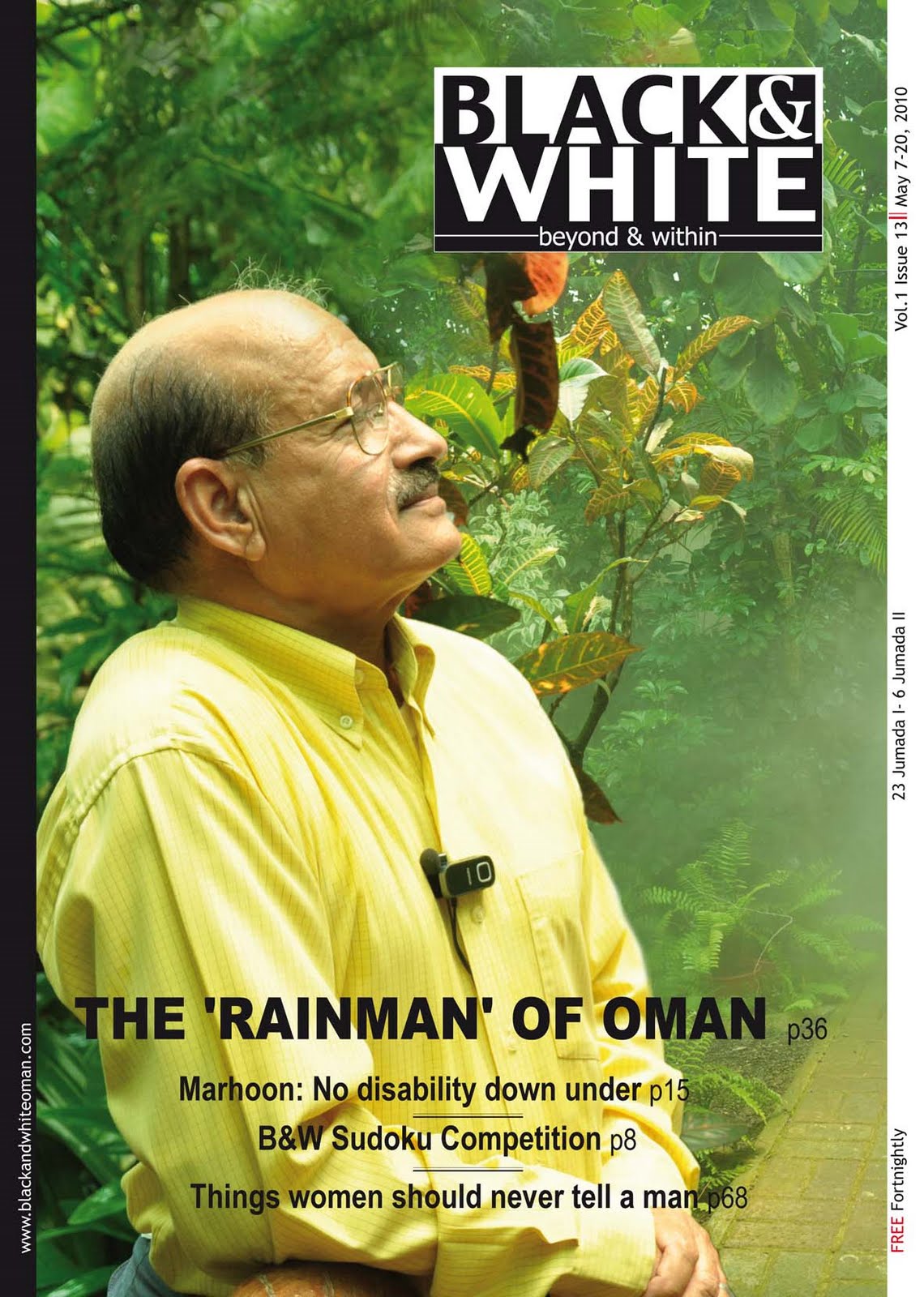
The ‘Rainman’ of Barka
BW May 7, 2010
“Wait and watch!” the duo said. One of them had that enigmatic smile playing on the corner of his lips. The other was jovially grinning from ear to ear unable to conceal his glee. It was around mid noon. Outside the enclosure where we sat, ensconced by green foliage, the temperature was doing 40 to 42 degrees Celsius.
Inside, where we sat, the temperature was around 26 or 27 degrees.
We waited, we watched. Then, suddenly, our ears picked up that rhythm. A distant rumble; the sudden drum of rain drops pitter pattering in the distance and then working itself into a storm, and – and in the next moment the whole area shuddered and coalesced with pounding rain.
Outside the enclosure, it was blazing hot. Inside, it was pouring rain. Something wrong somewhere?
No, things couldn’t be better. We were with the ‘rainman’ of Barka. “If you think Barka is hot and dry, you could be so wrong!” both J. S. Dadwal, senior general manager, Barka division, Al Bahja Group of Companies and Stephen Hatton, general manager, Al Nahda resort & spa chorused to us.
Yes, it was hot and sticky outside, but inside this verdant enclosure, it was monsoon at its peak. No, we are not in Kenya, Kerala or in the Khareef season in Salalah. We were at the ‘rainforest’ or simply put, the sprawling farm behind Al Nahda resort in Barka, enjoying an indoor monsoon. Some minutes ago, we were pushing ourselves through dense foliage in one of the many greenhouses in the farm to reach this little green and rainy corner.
It was a real oasis in the desert and certainly not a mirage!
“Isn’t it just like the Amazon jungle?” Dadwalji (as he is fondly known) asked us as the tempo of the rainfall increased. We did not know. But, we knew rain when we saw it; we knew rain when it soaks our body right down to the bone and these showers were like that, and punctuated with thunder and shrill bird calls. We sipped fresh grape juice as we listened to an unusual tale of some men who carved a green wonder on the desert. As they spoke to us, we realised that this oasis was just the beginning and they still had plans to create more wonders.
The ‘rainforest’ is a virtual Greenland behind Al Nahda resort, which was the brainwave of the former chairman of Ajay Group of Companies, the late Ajith Hamlai. The man who put the visionary chairman’s plan into action was Dadwalji and he is slowly bringing to life various dreams that the duo jointly planned. “Our chairman was a visionary, who had some 30 years back, planned this green revolution. He planted the seeds then and today, here we are, with that dream turning into a green reality – here we are standing right in the middle of a tropical rainforest!”
Often, when Dadwalji spoke of the late chairman, his eyes would mist over, but when he spoke of the passion behind making this green sanctuary, his eyes sparkled. “There is so much to say, it will take days before I finish telling you the story behind all this,” Dadwalji said.
Mere chance had brought Dadwalji, who was into R&D, botanical research, animal tissue culture etc., in India, to Oman. “I was with a reputed laboratory in Mumbai between 1987 to ’88, when chance brought me here to Oman. I was consulted to create oil extracts and to dispose of the residual extracts after process. I came to Oman to help produce essentials oils from Oudh, Rehan, Yash leaves!”
Apparently, 350kgs of Yash leaves used to be brought down from Jebel Akhdar then, to produce approximately 10 to 15kgs of Yash oil. “We were discussing what to do with the residues and the thought of creating tablets came up. These powder residues were harmless, but they were in abundance. Since we did not want to waste it, we began to make it in to sweet-smelling bukhoor tablets.”
The green visionary
“We were into the chemicals and extraction processes. And at the same time, the thoughts and ideas of making the farm green came up for discussions. That was the beginning of the small green revolution that took root in greenhouses, tropical rainforests, and later on to roses and orchids. There were no roads in this region at that time. It was all graded roads, and there was no landscaping. So it was more of a challenge for all of us. It was our chairman’s vision to create a green haven. We knew it would take years, but if we did not take the first step then, we would never be able to take it, so we took the plunge. Today, whatever you see in the 350 acres of land is the end result of that first, bold step taken,” Dadwalji said sweeping his hand across the greenery.
Mangoes and lemons
Dadwalji and his skeletal team began a small green house, with cucumbers and roses. The results were so positive that they created four greenhouses. “We made one exclusive for roses, indoor plants, and flowers. To be honest, at that time, there was no concept as such or huge manpower. We just had two to three staff and myself! We brought mango saplings and soon it grew up to 2000 mango trees. It took us three to four years. We have all sorts of mango varieties. We have one variety where each mango is 1.5kgs to 2kgs in weight. And we used many of the local variety saplings, later to be modified in to hybrid varieties. The end result was astonishing. This land is very fertile and gave us very fruitful results – very sweet tasting and big-sized mangoes. There is a local variety that bears fruits throughout the year.”
Dadwalji explained how such encouraging results gave them more confidence and slowly they ventured in to planting lemons, vegetables, in fact, every other fruit varieties. “But for apples, we grew it all here! Today we can proudly boast of a 75-acres lemon farm.
“And, as for mangoes, last year, we sold approximately 500 to 1000kgs of green mangoes a day. We reach it out to Al Mawaleh market,” Dadwalji said, adding that the period from June to July was the mango season.
Orchids bloom
Dadwalji and Stephen then led us into a greenhouse where orchids bloomed by the hundreds. “If orchids can bloom in Thailand, why not here in Oman?” Stephen asked out aloud as Dadwalji once again led us through an incredible orchid garden in full bloom. “We brought some saplings in a bottle down here and placed it in our greenhouse. Today, we have one of the most exquisite varieties of orchid right here in Oman!” Dadwalji added. The varieties present were dazzling. There was even a ‘non-vegetarian’ orchid that promptly fed on ants and other tiny insects that happened to be in the vicinity of the flower trap.
The wellness story
As more and more additions filled the farm, slowly the feeling came to them that they should go beyond being just a unique farm. “The greenhouses, the farms, the greenery brought us to a point where we wanted to share all of this with the public. The idea of wellness, spa came up and then we thought why not a resort? A resort that will feature tree houses, farms, mangoes, orchids, and peacocks.
And that is how Al Nahda resort came into being,” Stephen said.
Harmony with nature
“Needless to say, our late chairman was a visionary. He caused a green revolution in Barka. It takes many years of conceptualisation, initiation and hard work to bring out green results. Al Nahda is a wellness concept, a wellness created out of nature. Everything here is created as a compliment to nature itself. Being in sync with nature takes exceptional vision and I am glad to be part of the Al Nahda. Dadwalji is the green man here. The greenhouses, the trees, the peacocks are all manifestation of his dedicated efforts in live with the far reaching vision of our late chairman,” he said.
To visualise the creation of agricultural/horticultural landscapes for the local community welfare is not a simple process, he added. “This project has been happening since 1987 and today we have 350 acres which include lime plantations, green houses and nurseries, resort, spa, rainforest restaurant, rose, solar and jojoba gardens and agricultural lands, which include banana plantains, sugar cane, vegetable and natural foliage waste areas for compost development,” Stephen detailed. While the farm may dazzle with exotic flowers, plants and fruits, it was also a small zoo with a variety of birds and animals in wide open enclosures. “We have peacocks, peahens, rabbits, ducks, dogs…” Stephen noted. But the most exciting part was the peacock enclosure which had around 60 peacocks. The peacocks generally stand for auspiciousness and beauty. Two of them spread out their feathers in an impressive show for us.
By Adarsh madhavan, Najib Al balushi, Priya Arunkumar
Nature adopted me
Al Nahda resort has adopted some of the attractions too. Today, the resort has waterfalls, a 25mts long sauna tunnel, and fountains. A variety of trees dot the resort’s landscape.
Although Dadwalji spoke at length about the project, at no point did he take credit for the wonders that he had created. At the most, he would claim to have brought to reality the vision of his beloved chairman. “I will not take any credit for all this. I just love nature. And I am blessed that nature has adopted me. I love to be near plants and flowers. If you love nature, she (nature) will love you back. I am fortunate that I could be of use to this society.”
Think green
“We all should think green. It does not take much effort; it is just a thought that can soon be a way of life. I feel I have only done 30 percent. Another 70 per cent is still pending. I still believe it is nature that brought me here. I was destined to be instrumental to create whatever green I could with the vision of our late chairman… he is still in our hearts, amongst this greenery…” Dadwalji said looking into the distance, his eyes misting over again.
Maryam, the little curator

BW April 15, 2010
“Welcome to Bait Adam! You will see the history of Oman under one roof! My name is Maryam and let me be your guide for the day,” a pretty little Omani girl in a colourful traditional attire sings out at you in perfect English as she sprinkles rosewater on you. She gives you a card -- carrying contact details of the museum -- and then ushers you in to the Bait Adam museum in Qurum.
We have heard that Bait Adam housed some of the most unique collection on Oman’s history and featured rare coins, stamps, maps, historical documents and artifacts and most importantly, it was run by a well-known Omani collector. The well wisher who had asked us to visit the museum also told us to expect a surprise…All of that made compelling read and so we had excitedly trooped over there to have a firsthand feel.
At the door, we were greeted by this little girl with an impish smile. We later learn that she is the daughter of the owner of Bait Adam, the famous Omani collector, Abdullatif Al Balushi.
Before we knew it, we were transported into a magical ancient world, hitherto unknown, unexplored. A world where we hobnobbed with rare ghosts of the past, come alive by the sparkling narrative of a tiny young girl and the erudite commentary of a well-known and respected Omani collector.
Seven-year-old Maryam bint Abdullatif Al Balushi seemed like a fairy, and her little Omani walking stick looked like a wand in her tiny hand. She give us another little intro on Bait Adam, then excused herself and ran into the room and posed for the camera crew of Al Jazeera TV, which was doing an interview on her.
Today, the attraction is not just Bait Adam or the veteran Omani historian that is running the unique museum single handedly -- Maryam has become a star attraction herself being the youngest curator in Oman, plus Omani museum guide.
She breezes through the interview with the Jazeera scribe in Arabic and then returns to take us around, speaking to us in impeccable English, while her proud dad adds from the background that she is also equally fluent in Bulgarian.
She is fluent in three languages, and she is the youngest curator and guide of a museum, which is truly one of its kind! We realised what our well wisher was trying to tell us: The museum was quite an exceptional one, but the pleasant surprise was indeed the delightful little Maryam.
But, this little wonder is a recent addition to the museum’s attraction. Maryam tells us that she began this task only five to six months back. She had seen her father take tourists around his museum and detailing to them the intricacies of the ancient treasures inside there and like any child, began to emulate him. But, this was no mimicking, as Maryam was able to detail the particulars of the manuscripts and other items at the museum with the same ease as any seasoned curator.
She led us to a room dedicated to the historical relations between Oman and Zanzibar and gave us a good account of the items there. What was cute and endearing was to hear her detail -- Oman’s royal dynasty from the early pictures of the royal family posted on the museum’s walls -- in English, Arabic and Bulgarian. And, the transition from English to Arabic and Bulgarian and back was equally smooth. Her proud, doting father looked on from the sidelines, passing encouraging remarks and also filling in the little gaps when she inadvertently missed some points, or when the father felt that the detailing could be more descriptive.
Like daughter, like father
The father-daughter relation is also unique as both understood each other perfectly well and both seemed in sync. Other than some pointers, which the father discreetly told his daughter, the latter went on in full steam taking us around the museum and giving us a vivid picture of the artifacts there.
We probed into her background and how this cute little guide took to this extraordinary pastime.
Around six months back, Maryam tried switching off the lights inside the museum. But, she realised that she was not tall enough to reach the switch. “My dad had to come and do even that for me,” Maryam said explaining how that triggered off a need in her to help her dad who was singlehandedly giving the whole tour of Bait Adam. “So, by 2009 end, I began to help my dad, especially during the evenings and school holidays,” this bright and vibrant Grade II student told Black & White.
But, didn’t she find it difficult to learn all the intricacies of the museum items, most of them dating several hundreds of years back. “I actually find it fun. I know it is a responsible thing that I have to do, but my dad explained it in an easy manner to me, so it was not difficult or tedious to learn.”
Many people thought that she was too small for what she was doing, she notes a trifle petulantly, showing traces of her age.
“But, I feel very good and responsible. And all the guests who I have led around listened to me with great attention. I take them around for a stretch and then hand them over to my father, who gives them a detailed brief.”
Has she ever been overawed by the tourists, especially when the numbers swell? “Never,” she said, confidently staring back at us. “There was a time when she had ushered in guests who came in five buses, around 180 tourists, her father pitches in.
Bait Maryam
Maryam has one brother, who is elder to her. The museum is named after him. To stave off unnecessary sibling rivalry, her father quickly built another section, separate from that and named it Bait Maryam. Maryam also gave us a quick tour of that section.
In every other respect, Maryam is just another seven year old. She has a large tree house, and she has her toys, a pet doggy, Mielle. “Come and see my tree house,” she said, taking us to this large, double storied tree house. “I can watch DVDs inside and even sleep off there, if I need to,” Maryam said, also reeling off names of her other pets: a parrot, turtles, rabbits and iguanas.
Tourists who visit the museum are clearly bowled over by the vivacious little girl, who has somehow managed to find time for both study and play and yet indulge in this museum task. We ask her what she wants to do when she grows up, and for a moment she thinks…she is not sure. “Maybe a teacher, or a doctor…but, I will also be doing this (she indicated the museum).”
Like daughter…
“Maryam has some special sections in the museum and she handles that. The others, especially the main briefing, I handle,” Abdullatif Al Balushi tells us. Asked how he felt about his daughter following in his footsteps, Abdullatif said: “Maryam is like the face of Oman, traditionally dressed up, ever smiling and exuding warm Omani hospitality.
She is a real help to me. My daughter has that cute, childlike charm, which the tourists find quite endearing, and she engages them with her sweet and crispy chatter. She has learnt all the facts by heart and also by understanding. From my side I feel elated that she has shown interest in learning the history of Oman. Although she is just a little girl, she is quite fascinated by the slices of history housed in this museum, but, more importantly, she feels she is responsible to assist me in my briefing. I only hope both Adam and Maryam takes this museum further after me.”
But, this is the only time, throughout our interview with the father and daughter that the former evinced such a hope. Otherwise, he did not make any such comments. On the whole, Abdullatif is a man who can take pride in being the only man in Oman having such an unusual and rare private collection. And he has managed to this huge task alone. The only driving force in him is this indescribable passion for all things Omani – the past, that is. He has an eye on the quaint and unusual aspects of Oman and the country’s relations with other countries and their leaders. A quick tour of the museum will unearth many rare beauties, which collectors around the world would die to posses. Many are of great value to Oman and offer a unique insight into the scenes and times of an era that has past.
As a collector, Abdullatif began like anyone else, collecting the odd things like coins, maps etc. But, this childhood hobby soon became an all encompassing passion, which has resulted in obtaining some priceless historical antiques. “Since the last two decades, I have been collecting a variety of antiques. I have a great desire to preserve my nation’s history; I feel it is my responsibility and it has slowly become my purpose in life.”
And that meant everything. When your work becomes the main purpose in your life, everything else is secondary. For Abdullatif, it is this single-minded devotion to his work, to his collecting, that has transformed a simple collection into what is today a treasure trove of Oman’s extraordinary past. “Some of the items here are so rare that virtually no other collector or museum here or in the world has it,” the maverick curator tells us, detailing at what lengths he goes to get a rare piece when he stumbles on a clue. For the uninitiated, the world of collectors is a strange one. Many are known to have an unerring sense that helps them track down some odd piece in some forsaken land and they latch on to it only for the rest of the world to realise of its potential later. Abdullatif is no different. With just a small hint, he has been able to track down some valuable pieces from different corners of the world. “All of it, sitting in this same museum,” he chuckles. Of course, he has his ways and means.
No support
He is no longer negative about the lack of support for his museum and the sheer apathy many in the private and government sectors have shown for this remarkable institution. He feels that some day, someone will reach out and give him and the museum that support it desperately needs.
“Today, all I can say is that Bait Adam houses some of the most unique slices of Oman’s history. Some items here are priceless as well as irreplaceable. I can proudly say that there are some artifacts that are one of a kind.
“Take the example of this gift of H H Syeed bin Sultan to the seventh president of United States, Andrew Jackson. The gift is an ivory chess board given to the US president in 1833. The uniqueness is that the original gift is housed here along with the original letter of H H Syeed Sultan. That is the first piece of antiquity that will welcome you at Bait Adam. It took me 20 years of sheer research to finally unearth this precious piece.
“Bait Adam has many such pieces. I created this museum some eight years back in 1999. I was a government employee and I retired in 1991. Since then I am in to creating, updating and researching for this museum. There are times when I feel let down, when I realise it is just a one man show with no support from the public or private sectors.
“Think about it: What am I doing here? I am preserving history of this great nation… what could possibly be wrong about that?”
Abdullatif’s passion is an expensive one too. “Creating a museum, procuring antique items is an expensive affair. It is not just the years that I have put in; I have invested quite a lot of money along with my heart and soul… I only hope it continues to the future, so that the younger generation can one day see it all.
I am a private collector, but I am proud to say that Bait Adam has a rare and unique collection of artifacts from Oman’s history. The displays are all laid out aesthetically in five galleries. I am the collector, curator, researcher, investor, escort and the interior designer too. My library has the rarest of the manuscripts too.”
Lack of awareness
Like every other museum, records have to be maintained. Researches have to continue. But, Oman is still in its primary stages of archiving, notes Abdullatif. “The value of historical collection is not accepted in its true worth. Oman’s history is not about khanjars, dish dashas, potteries or masars. It is much more than that. Many of the historical artifacts have be bought over or taken away from our land. We need to bring it all back.
But again, awareness is required in our society about the importance of preserving history. There is an Arabic proverb I would like to quote… ‘for the one who does not know the worth of a falcon, it is just chicken meat!’
So it is time to gear up and create awareness amongst all to join hands to preserve a valuable slice of history – for history is part and parcel of every nation!”
Dream collection
“I have been collecting for over 40 years and spend 20 active years on research and procuring artifacts. Running a museum as an one man army is a very challenging and taxing role. There are many things out there which I would like to procure. It needs lot of money. Like the proverb in Arabic, ‘the eyes can see far, but the hands can’t reach…’ Still, I am happy; I have fulfilled my mission, I can relax now,” he says with that inscrutable and faraway look in his eyes.
By Adarsh Madhavan, Priya Arunkumar, photos: Najib Al Balushi
Say Cheese!

Cheese for charity
BW April 1, 2010
It is just 4am, but Khalsa bint Said bin Majid Al Ma’amari is already up and about. From 4am to 6am, this Omani mother of 12 will be engaged in making a variety of products –butter, laben, cheese -- from milk and then waiting for the people to stream in. Soon enough, half a dozen men, women and children will turn up at the doorstep of their large and spacious farm house in A’Tarif in wilayat Musannah for their dole.
Khalsa Al Ma’amari has been doing this for the last 32 years: Doling out cheese and other milk products for the needy from her home every morning. Like their large farmhouse and the big seven acre farm, Khalsa and her husband, Ali bin Humaid Al Ghassani (a former ministry of education official), have large hearts and they keep open house for their cheese and other milk products every morning. A variety of people from the neighbouring community and otherwise come and savour the delicious ware of Khalsa, or take it home for their families.
“I start my day at 4am with churning of the milk for butter, then curdle it with a little laben, then go on to make cheese and melt the butter for ghee. These two hours are an integral part of my life,” Khalsa tells Black & White.
A juggler par excellence Khalsa is a strong, independent and hardy woman with an energy that is not only robust, but also inspiring. She is like several women rolled into one and she has the ability to work nonstop. Today, she is more at ease and the workload is decidedly less because, except for one of her daughters, the rest of the 11 children have flown from the roost, some abroad, some to distant parts of Oman and the like.
But, years back, she was looking after 12 children (10 girls and 2 boys), her farm and also making butter, laben and cheese for several people on a daily basis. Milk was in abundance because she had 30 cows then. But, how she managed to juggle with caring for so many kids, and still continued with looking after the farm and reserving time for charity is unfathomable, but she did it –and she did it in style, with minimum fuss. In all this, her husband stood like a rock, supporting her at every venture.
Smooth transition of a traditionLaben, butter and cheese making were traditionally passed down to her from her mother and mother-in-law. Marriage also did not stop her from her helping mentality. In fact, she seemed to have gained more focus from her husband’s guidance. But she was actually inspired by both her mother and mother-in-law as far as making and giving away cheese was concerned. Both of them used to give away to charity, but most importantly butter and cheese.
Why charity?But, what does she get in indulging in this charity? A beatific look followed by a simple, happy smile gave us the answer. She added to that by saying, “doing good only begets good – it is good karma!” Again, that beatific smile.
“We gave away the cheese and other milk products to the neighbourhood folks and also passing travellers. The word got around and now the volume of cheese we give away has increased manifold. Whoever comes by get laben and curds.”
The only thing she sells is ghee (which she sells at the rate of RO5 per bottle).
“Other than the ghee, I give away everything else. I still remember in the early days, we used to make balls of cheese and dry it up in the sun and these cheese balls used to be given away.
Later, we started giving away normal fresh cheese. Today, people prefer wet cheese rather than dried cheese balls, so we continue giving it away.”
She makes all these products almost singlehandedly. A Bengali helper, Shams Ul Alam, helps her milk the cows and also look after them. “Shams Alam has been with us for the last 32 years. Other than milking, I do all the chores by myself. Of course, my youngest daughter, Maryam, lends a hand.”
3700 chickens as hobbyAbove all this, Khalsa had a chicken hobby some years back. She used to raise chickens. She bought 40 chickens spending RO20. Each chicken cost 400baisas, and she raised them and sold it for 700baisas. She began this as fun and then suddenly the hobby began to gain unusual grounds. Soon, she reached a stage where she had more than 3700 chickens. “I had incubators, all accessories for maintaining a chicken farm. My efforts were recognised and even awarded by the Ministry of Agriculture too. That was a real confidence boost.” She however gave it up and her brother took charge of the project. But, Khalsa is restless now and is eager to begin a renewed tryst with chickens.
Her application for the same has been approved and she is just waiting to start. “But this time, we have goats too.”
If she had only studied Was she always as happy, as confident and as cheerful as this? Does she have any regrets?
Still smiling, she confessed that her only regret was not having been able to continue her education. “I am a sixth grader; due to various circumstances, I could not continue my education. That is my only regret. I wish I could have studied and I still feel I can. I believe education would take a woman to better heights and give her more confidence and opportunities. Education opens her mind and helps her perform better.”
A leap out of the Springboard programme She had a brief brush with a personality and confidence development Arabic programme (Springboard) organised by the British Council. She got this golden opportunity to attend the course through Nissa Sidab, an Omani women’s association in Sidab.
“At first, I was shy when I realised that every other lady participant was not only educated, but very well established.
“I was the least educated among the lot. I attended this course only to meet up with people. I love being with people and thought this would be an opportunity to meet new ones.
But, the course addressed all of us equally and I have come out with better exposure to opportunities. I may even take up new projects soon, like making cream out of milk. Ladies need to be empowered and for this we do not have to wait upon anyone. We can empower ourselves.”
But, Khalsa is quick to point out the unstinted support she has from her husband, which has spurred her to these heights. “A woman needs her family’s support to shine.”
Farm tour Khalsa gave us a tour of the farm, the inhabitants of which included several cows and calves, turkeys, goats, rabbits, hens and chicken end even fishes (in a huge water tank).
Besides the animals, the farm had almost every necessary fruit trees like dates, papaya, plantains, badam, berries and sidr. A lush green patch of grass was fodder for the cows
How does she manage to take care of the large farm? “It is not easy,” she agreed, but a natural inclination for animals and fruits and trees spurred her on.
Any challenge can be overcome She did face quite a number of challenges earlier, especially when her kids were young and at a school going age. “I had to drop them to pick and drop them to school first and then get on with my daily chores and then take care of the chicken and other projects.”
The daily cooking, washing, cleaning, rearing children and producing the cheese etc was difficult, but, not impossible. A woman is successful if she can prioritise her options and duties well. She cannot afford to choose one duty over the other. Effective time management will accelerate her growth and performance, she said.
Equal to any man“I believe an Omani woman is equal to a man in all aspects. In fact she is better in handling multi tasks and more patience in her approach. She can take up the burden with ease, naturally. God has created woman with many qualities. All she needs to do is find out her strengths and work hard. I am sure she will succeed.”
On a given day, Khalsa’s work begins from 4am or 6am to 10pm. And she is fully occupied throughout these hours. “But, today with all my kids being grown up, she considers her weekends as the busiest days.”
She has 17 grandchildren and during the weekdays, the farm reverberates with their laughter. “I really enjoy being with them during the weekends.”
Regrets and dreams
What were her dreams? “I dream to be able to study more. My only regret is in not having completed or pursued my education.
Education is a must for every woman. If you educate a lady, you educate a generation, they say. I only wish I had studied more. My children have been fully educated and I am happy about that. When I had free time, I took up computers recently and studied it. That is all. But, my mind still yearns for more. I don’t think it is late. Now I have more free time, so I will pursue my education.
My dreams are mostly limited to my family and my projects.”
By adarsh madhavan, Priya Arunkumar photos Najib Al balushi
Sunday, July 25, 2010
Honeymen in Feequin

‘Honeymen’ in Feequin
BW March 15 2010
Mohammed bin Rashid bin Waleed Al Busaidi gingerly plucked a hive swarming with bees from its home (a small brick structure) in his farmland in Feequin and displayed it to us. Bees swarmed him, but, surprisingly none bit him, or us, who were within close proximity.
Full with the belief that bees would attack us, we were more concerned about our safety than getting the story, but the 75-plus Mohammed Al Busaidi put us at ease. “I have never been bitten before and they won’t bite, relax…”
So, we relaxed and as the bees droned and hummed around us because they were slightly disturbed, Mohammed declared solemnly: “It is from these bees that you get the best of honey in Oman!”
This was no mere boast. The small village of Feequin, which is some 22kms east of Nizwa, is considered to be the ‘honey capital of Oman’, and its residents, are all savvy of the honey making business, because it has been part of their tradition here.
Mohammed, one of the oldest member of this honey business and still happily pursuing this trade, says that today, it was an admix of a career cum hobby for him. He used to have a government job before and at that time he took honey making and trading as more of a hobby. But, after retiring from his job, he is now into this trade, fulltime.
“Currently I have over 30 to 40 hives. During the seasons, I can make around 40 to 100 honey bottles and I have a proper market for it.”
Mohammed’s day starts at the crack of dawn. “I am up very early in the morning, and after my morning prayers, I start off with my bee hives,” he tells Black & White.
He explained how he worked on the hives, building partitions, cleaning up, setting their homes etc. “It may look quite hard, but, honestly, by noontime, my work is over,” he gleefully explains. “I don’t know whether to call it a job or a hobby. Whatever, it occupies my full time now.
“It is very much a part of my life now and even though it may not enjoy the glory of a time past, I think the future is promising,” he said, highlighting the exciting moments that he had in the past.
A decade or so ago, Mohammed, who was rummaging in the circuit of Mannah, some 30-odd kilometers away from Feequin, stumbled on one of the biggest hive (in his experience). “I got four bottles of excellent quality honey from it.”
Mohammed sold small bottles for around 25rials while larger bottles were sold at 80rials.
Later, at his home, as we sampled fresh honey along with some paper thin Rukhal (a type of Omani bread), Mohammed gave us his tale of honey and beyond:
Honey village of Al FeequinAll of Mohammed’s ancestors lived in Al Feequin. “I was born here and I can say honey and beekeeping has been part of this village for many years.
“As for me, I began collecting honey when I was a young boy of 10. I am into the honey trade for the last 40 to 45 years now.
“My father was very passionate of this trade and he was considered one of the best ‘honey man’ in this region. Nizwa and Rustaq are the centres for honey and Al Feequin used to be one the most sought after honey centres in Oman. I used to work in the ministry of defence before, but, currently I am fulltime into the honey trade. A few of my sons help me, but, I do it full time by myself.”
Mohammed explained that Oman has two types of honey bees: big and small. According to him, the small-sized ones make the best variety of honey. “Honey trading is a good business. It used to be better in those early days. But no complaints, I can still make a good income out of selling honey.”
Three seasons for honey
In Oman, there are three seasons for honey. Two of them are in the winter months (February and November) and one in summer (May/May end). The honey is harvested during these months.
“During winter I take the bee hives to the mountains or the forests, because it is during this period that the Muscat Municipality sprays disinfectants and it will harm my bees.
“I keep my hives away in the plains some 40 kms away from Feequin.”
Mohammed’s passion for bee keeping and honey making is quite evident. In fact, he is passionately attached to it.
But, he feels he could do a lot better in this trade with a little more support from the local authorities. “It is a good trade. During good seasons we can get 40 to 100 bottles of honey.
“Currently I have over 30 to 40 hives and every hive needs a queen bee. In the earlier days I had around 100 hives and queen bees,” he tells us.
Where the Queen is King The queen bee is indispensable in this business of honey. No queen bee, no honey, it is as simple as that.
Mohammed tells us how, in the earlier days, during the time his father was the king of the honey trade in Feequin, they used to get the queen bees from the jebels. “We follow the same pattern. Once the queen bees breed, we have no problem. But, when there is a dearth for them, we scour the jebels and the forests, catch them in special cages and bring them back.”
Like all animals and insects, the bees come to wet their parched mouths in the water holes. Once they have had their fill, they return to their hives, and bee trackers like Mohammed adeptly trail behind them.
A captive queen bee lives for four to six years, but, she is productive only for three years. “I still search for queen bees whenever I am out in the jebels.
“We keep them in separate partitions. Two queen bees can never be put in the same cage, they fight and kill themselves. But we can keep four to five together.”
Omani honey the bestIn Oman, the Dakhliyah region is known to have the best variety of honey. Batinah region also has good honey too, but, it is lighter in nature. “Shuhoud is a high quality variety and Rahyah is the second best. In the Batinah region, the palm trees are more and people make beehives out of date palm trunk usually three to four feet in length and hollowed out and the honeycomb and the queen are placed inside. Ingenious ways of harvesting the honey and combs are done from the rear of the date log hive to minimise disturbance to the bees. Here in our village we are dependent on sidr trees. Oman can proudly boast of the quality of its honey in the region. I have customers coming from the United Arab Emirates and buying honey for 100rials.”
Mohammed said the honey created by the small varieties of bees are unique in this part of region and are the tastiest. “I only pray there are more rains, so there is more water. It is the water and greenery that brings the honey bees to us. In the earlier times, we had lot of greenery, which is now scant now.
“Our prayers and wishes are for Oman to have more flowers. The quality of honey depends on the trees and flowers from which the nectar is collected by the bees. The Sidr trees are very good and the honey from it has a pleasant smell. It is very thick and has very good taste. It fetches good rates too. There are cheaper ones, which are thinner in nature and we sell them for 25 rials per bottle. You can buy these at the Nizwa souq.”
No dearth for honeyMohammed noted how, earlier, there were only a handful of the villagers and there was plenty of honey. “Of course, there is no dearth of honey and bees today. It is just there are more people getting into this trade. All we need is more water, trees and flowers. I hope more and more youngsters take up this trade and create a market for this trade.”
Speaking to us, Mohammed took a dab of honey in his hand and as the golden drop glinted in the sunlight that streamed into the room, he said: “Honey never gets spoilt. It has a good shelf life. The older the honey, the tastier it gets. It is a good product worthy of your time and investment. It has immense medicinal properties and it will always remain an integral part of our lives.”
Honeymen of Al Feequin
Before we met Mohammed, we had bumped into Mohammed Hilal Al Busaidi near the Feequin fort. He led us Nasser Hamoud Saif Al Busaidi, one of the younger generations of Omanis, who were equally passionate about honey making and all that went about it.
He led us to his home where he brought out a freshly plucked hive and took us on a brief journey into honey making.
Nasser Al Busaidi noted that their ancestors in Feequin village began this ancient tradition of honey making.
“Today, it is a family tradition for me. You can find little boys hunting for honey here. What starts as a childhood hobby, slowly becomes a full time hobby for us. It has happened to me.”
Nasser’s father used to do it on a large scale and he had many bee hives. Honey making and setting up beehives used to be the main hobby for many of the villagers of Feequin. “I grew up seeing our elders hunt for the queen bee, searching for hives and setting up hives for making honey. Omani honey is considered to be one of the best in the AGCC region and good honey can cost up to 80 rials.”
Nasser began his honey hobby when he was just 10. “I think most kids in this village grew up with this hobby. Because of the history of the elders in the village tending to bee keeping, our village was famous for it. All of us have our own hives and we somehow find time to this hobby.”
Nasser took us to a space behind his home where he kept the hives. According to him, the honey during winter was much better tasting and thicker than summer. There are five types of tree from which the bees make their honey: Sidr is the most common as well as the most famous one. Then it is Harmel, Sarhah, Sumr and Assr. “Both, the seasons of Sidr and Harmel are over. The Harmel season just got over recently.”
Nizwa and Rustaq are the honey centres. “You get good honey in Salalah too, but it is thinner. The best varieties are from Nizwa and Rustaq. And the village of Feequin has got the best. The numbers of honey makers in our village have reduced to three or four. But, we still are in demand. It is a trade, in the season we sell up to 30 to 40 bottles. We get order from many. The consumers know it. We even get orders from the UAE.”
Nasser’s father used to bring the queen bees from the mountains. “I still do it. I have a very close childhood friend Ahed who tags along me to the jebels to help me bring back the queen bee. Bees need water and they build their hives next to the water resources. When we see a bee drinking water, we know there is a hive nearby. Then we start looking for it.”
By adarsh madhavan, Priya arunkumar, Najib Al balushi
Captain Juma, the sailor at 12

The adventures of Captain Juma, the sailor
Will God fulfill the prayers of old men whom time forgot?
Will God heed to the desire of a proud, old Omani sailor?
These queries played in our mind as we talked to a venerable old sailor, a former ship (dhow) captain, and an icon of a proud part of Oman’s history, who while lovingly caressing a miniature model of a dhow at his home in Al Hail South, was also saying that given a chance he would sail an Omani dhow once again. Even though he was old, tired and his sailing days were all behind him.
Captain (former) Juma Said Salem Al Ruzaiqy pointed to an elevated spot on the vessel and said that from that vantage point he could see everyone on board the vessel and the sea. “This is where I used to stand,” he told Black & White, his once-tired eyes gleaming with a mixture of emotions: pleasure, pride, and perhaps a tinge of sadness. He could not take his eyes off the miniature vessel, made in the likeness of Al Ghanja (a type of Suri dhow/boat).
“My sailing days are over,” the 75-plus sailor and captain who had sailed for more than 50 years wistfully tells Black & White, adding however that he wished to sail once more. “I want to become the master of a ship, steer it to safety…just once more,” he said in a voice heavy with experiences and remembrances of sails past.
Praying somehow that his dreams would come true, we listened to Captain Juma Ruzaiqy reciting some moments of a glorious past. He told us the tale without remorse, regret or self pity. It was a hard life on the sea that he described, but here was a man who took everything that fate threw on him and accepted it. If life was tough then, it just so happened that he was a bit tougher.
For a boy who took to sailing at a mere age of nine, sailing was the only profession and life that he knew. But the sea has taught him the most valuable lessons that life could ever teach anyone. And, one of the most important lessons was patience, Captain Juma added to B&W.
For Capt Juma, patience was the key to his success; to a successful sailing and trading career. On the sea, the odds that they faced were mostly insurmountable. “But with the fortitude of patience in us, we could face anything. Because we knew that the bad times would not last and even if we were totally away from land for months, we would still somehow reach our destination. Despite confronting the worst of moments, worst of storms and despairing moments when we would be lost and off track for weeks, we still had the patience to wait for the seas to calm, for the path to clear, the winds to settle and from dark moments of loneliness and fear of the unknown to turn into utter bliss, togetherness and happiness,” Capt Juma said.
Good old years
“I would love to live those days all over again. I still prefer to go back to my old life and be part of the older generation,” Capt Juma said, slightly bent over on his chair at his home. “Our focus was not comfort and easy life. Yes, it was a tough life, but we were tougher. We were people with tremendous amount of inner strength; our hearts were more open and we were not burdened with guilt like the youngsters of today.
The comfort and easy life has made the younger generation weak and dependent on others. We were self reliant and self dependent. But, then we had no choice. We had to. I have had a full-fledged and a satisfying life. I have fulfilled my mission. I have no regrets whatsoever. I had a good life and I am still enamoured by the sea…”
At that time, Capt Juma was one of the youngest one to have sailed on a dhow. He was merely nine then. “I had completed my certificate course at the Quran School. Formal education was not easy to come by. I did perform well at school; after passing the course, the only option I had was to join my father on board the dhow.”
Harsh sailing life
But, life was not hunky dory. “A life of sailing is a harsh one; but it makes you strong. A sea never hurts you and it teaches you what you need most in your life – PATIENCE! I learned it the hard way, it taught me strength, it taught me team work. Those unexpected storms and strong winds and dead winds were the dangers we faced those days. Imagine being on a wooden ship, with no engine or motor totally dependent on the winds? If there was no wind, life would literally come to a stand still…”
Memories: sweet and sour; salty and bitter
Capt Juma had an answer to almost everything we asked him. At times, he mentally pored over a query and then unveiled slices of his sailing life. At one point, he went very quiet and then slowly, he told us of an incident on the sea, when they were lost in sea, in the middle of nowhere. Capt Juma and his crew were stuck between two opposing winds and they literally stood still for days. Strong westerly winds then blew them off course and they had to literally resort to an alternate route on their return journey to Muscat from Mumbai. Their reserves had run out and they were on their last leg. He put his distress flag out and finally a passing steel oil ship yielded to their SOS. By this time, they were somewhere near Sugatra (near Yemen). A boat was sent by the oil liner to the captain of the dhow.
Kid with a strong heart
Capt Juma gently rubbed his cheek with a glint in his eyes and a hint of a smile on his face as he recalled these moments. “In shipping circles, I was just a kid and I looked it too, without even a hint of a growth on my face.
“The captain was quite taken aback when he met me and asked several times whether I was actually the captain.” Seeing the youngster who claimed he was at the help of the vessel, the captain feared that the dhow was in danger because of a rank inexperienced hand at its helm.
“The captain looked down at me and gave me a series of tasks to do to prove that I could handle my vessel. ‘You are too young to be the captain of the ship. Tell me the position of your ship,’ he asked me sternly. He got a map and asked me to pinpoint our current position.
“This was not a difficult task for me: I pointed to the map and said, ‘we’re here – 12 noon!’
The captain’s eyes popped out: ‘Dead on,’ he said, slapping me on my back. ‘Dead on, lad,’ he said, almost hugging me. Then he transformed himself from a doubting Thomas to a fountain of plenty. He gave us water, provisions and even a gift for me. “The experience was a lesson for all of us!”
Sailing at nine
This was nothing unusual for Capt Juma was just nine when he joined his father on the ship to India. “They say necessity is the mother of invention and that is how I took up sailing. My family had the necessity to take up sailing. My sister, older to me by two years had some eye problem and since Mumbai had good medical facilities, my father decided to take her there.
This is how I began my sailing career. I became a trader for many companies and started sailing to Mumbai (It was called Mumbai then during the 1940s, not Bombay, he clarified).
“If the winds were favourable, it took me and my crew just seven days to reach Mumbai. Otherwise we could be sailing for over a month, from Muscat to Mumbai and back. Normally we stayed one month at our destination, before we start our sailing back.
“In those days Sur was a trading centre and its only other competitor was Kuwait. Sur and Kuwait were filled with demand and supply of merchandises from Mumbai, Karachi, Burma, and Madras etc. Sailing was not new to Oman. It started very early and many Omanis set off from Sur, to the adjoining AGCC countries and other coastal towns to far China, India and Africa in search of fame and fortune.
I have sailed to India frequently and to Pakistan, all the AGCC countries and Africa
My father and grandfather have sailed up to Madras, Siam (Thailand) and even Madagascar.” Capt Juma’s family owned over seven ships – at one point they had three ships sailing -- and we had our own shipyard. Sur was the only centre in Muscat that had trading at its peak.”
Salted fish, lemons, and dates
Other than Arabic, Capt Juma could also converse in Hindi. He could also handle English and a bit of Swahili.
“Have you heard of Surmai machi?” he asked us in Hindi… “That fish is named after Sur and I am sure it is still available in Mumbai. We used to fish for 30 days or more and salt the fishes and take it up to Mumbai to sell. Other stuff traded included salted lemons and dried dates. We brought back rice, cereals, spices, medicines and many more things from Mumbai.” He also remembered his connection with Kerala. “Calicut (Kozhikode) and Beypore,” he said, his face breaking into a smile.
Cut out for sailing
Capt Juma noted that he was dependent on ships, throughout his life. “As sailors, we had our lives cut out for us. We were alive and everyday was a challenge. Yes, it was a very tough life. We were out in the vast, empty ocean and at the mercy of harsh nature for days and months. Our family owned seven big ships which we acquired for trading purposes. We had contracts with various companies and we brought cargo for them. The 1940s saw Sur as a busy trading centre and without any other transportation facilities ships were the only means for trade. Two of our family ships were biggest in the whole region.”
Omani ships, built to last for 100 years
Omani ships, which can last for 60 to 100 years, are distinguished by their variety of types although some are no longer made. The largest type was the ocean-going cargo vessel, the Baghla with a length of 135 feet and a load capacity of 150-400 tonnes, which could be distinguished by its high poop deck and quarter galleries.
Al Ghanjah was very similar to the Baghla, and is considered by many Omanis to be the most beautiful of the large dhows, Capt Juma noted.
No one wants the long, hard route
“The seas and sailing were the only means of money for our family and we chose sailing as our profession. No regrets till date and I am still wanting to sail more. Sailing is my life and it is sad to see that the younger generation will never experience it on sea.
It is not modernity, it is the progress of technology and transportation that has created newer sources of trade that has brought a decline in trading by sea. Today no one is dependent on the sea routes. The air cargos, the land transport has developed by leaps and bounds – so why choose the long hard route?”
Oman’s only master ship builder
Sur, on a sleepy February afternoon is just that: sleepy. But, along its harbour, considered to be one of the oldest in the world, there are some buildings dedicated for shipbuilding. Enter one of these and you will bump into one of the only Omani ship craftsman/builder alive, who is still fully engaged in the ship building trade.
Ustad Juma bin Hasoon Juma Al Araimi, 70, is neither sleepy, nor lazy. And neither are his workers, all immersed in the activity they know best.
Master craftsman Juma Hasoon is still active as the first time he took a ship-building tool, some 55 years ago in Kuwait. He returned to Oman 16 years after, taking up the reins of shipbuilding in 1971 and thereafter building more than 2000 vessels, most of them costing over 90,000 rials (to be built).
He is the only active Omani ship builder left in Oman. But, neither is he a relic or a man with a singular past alone. Juma Hasoon is today a timeless reminder of the glorious shipbuilding past of Oman.
He is also keen that this ancient craft of building wooden vessels does not die with him. “I have trained my three sons in the same trade and I have 10 expatriate workers too,” Juma told Black & White, taking some time off from his busy building schedule to talk to us.
Juma was keen to spend some time with us so that he could unveil some nuggets of information of his past, thereby preserving some salient points of a glorious era to posterity.
But, he is neither sad nor depressed. Although times are tough now and there is hardly any shipping activity to speak of, Juma is confident that he could spark the ship building desire in young Omanis to continue, as he noted, a “glorious tradition”.
Legendary ship builders
In the earlier days, Juma used to have over 40 workers under him. “The demand for ships was very high then. I remember a time when there were six shipbuilders (including him) in Sur. Five have passed away. Only I am left today. Mohammed Khamis Al Shagagh, Yakuth Suleim Al Ghailani, Ismail Hasoon Al Araimi, Rubaiya Hamad Al Araimi and Mohammed Hamad Al Shagagh were the other five,” he said, reeling off the names of his now-dead contemporaries. “They are no more today, but they were some of the best builders Sur ever saw.”
Juma also described a former legendary ship builder, Khamis Al Jhowi, who, he said, could merely feel the wood and instruct how to build. Khamis died last year. “Another good ship builder was Zubait Khamis Al Alawi, but he is too old today and has retired from the trade.”
Passing a legacy
Most of the Omani ship builders have left the trade because of the lack of demand. “I will not blame anyone, it is just that life styles have evolved and modernity has made lives easier and faster for all. Ship building is not a fast-paced activity. A person or business house building one will have to wait for nearly six to eight months minimum. We do not build a ship for ourselves. We do not hold stocks too. Only after the order is placed we start to build.
“My three sons, Saleh, Ali and Khalid are trained in this trade. I don’t have the heart to let the ship building die. It will eventually, but as long as my family continues in this trade, I feel there will be someone to take the trade forward.”
Seven shipyards in Sur
Juma explained how during the time when the ship building trade was at its peak, Sur used to have more than seven shipyards. Today at the place where the largest shipyard used to be has been redesigned as a park!
Juma noted how ship building was not just a passion, but more importantly, a family tradition. “My father, grandfather, uncles were into ship building. So I was groomed, taught and trained by the best in the field then. I dot keep count of how many ships I build, but I can say definitely over 2000. I have built ships for Qatar, Bahrain, Kuwait and Oman.”
Day begins and ends with ship building
For Juma, building a ship is like breathing. He has to do it to keep himself alive. And Juma, despite his age, was as sprightly and energetic as a teenager. “My day starts and ends with the making of the ship. It is a tough job, but very satisfying.
“For me it is a family tradition. I don’t know of any other trade. Being a native of Sur, the sea is an integral part of my life. Other than Sur, Kuwait is one of the major centres for trading and ship building. These ships were basically created for trading. The sea route was the chosen one for trading since centuries. That made ship building a part of Sur and its people. Sur can boast of many talented and professional shipbuilders and traders.”
Building a ship is tough
Then and today, building is a ship is tough business. “First of all there should be a demand for ships, which is slowly declining. Today, the trading or business houses are not dependant on dhows or wooden ships. The fibres have taken over. And it is easier and faster with fiber building. A wooden ship takes a lot of craftsmanship and time. It is expensive too. It requires 90,000Rials to build a big ship. It takes around eight months to build a big ship, while a small one takes around six months. Wood is a dependable element. Oman’s temperature gets the wood in a proper and perfectly dried condition. I only take time off for my prayers in a day. I have dedicated my complete day to the ship building trade.”
Box/separate
Six types of ships
Sur boasts of six different types of ship: Al Ghanja, Boom, Sabookh, Badan, Jalbooth, and Shuwaiei. Al Ghanja is the best and popular one from Sur. These ships are mainly created for shipping cargo – trading -- and fishing. Nowadays it is used predominantly for races and for tourism. “I only wish and hope that the authorities will take up the trade and pass it on to the future before it becomes extinct and just history,” Juma opined.
The wood for these vessels usually came from Malaysia, India, Burma, Africa etc. But the designs came from the craftsman’s head. “We carry the design parts in our head. I do not follow a blueprint or a design. The building process depends on the length and breadth of the ship. Once that is decided and ordered, the other parts can be created,” Juma said.
Omani dhows - the best
Support or interest from Oman Inc is still not very forthcoming, but the Omani corporate does order ships for taking part in boat races. “I am very proud to say that I have built many such ships for races and these ships have always emerged as winners.”
“I remember one such instance where the organisers of a race in Dubai actually said all ships should be of the same origin (as the country where the race was being held) and thereby the Oman team was not allowed to use Omani dhows...,” Juma said, adding with a laugh that this rule was applied because Omani dhows always won in such races.
Was there any special vessel that he created and was there any one of them very close to his heart?
The master craftsman loved all of his works of art: “I love all the ships that I have created. Yes, one special dhow, which is close to my heart is the one largest ever dhow - Al Messarrah -- made in Oman – it was made for the Royal Yacht Affairs, in August 2005.
Like father, like son
We also spoke to one of the sons of the master craftsman, who Juma fondly hopes will carry on with the trade. The ship building yard of Juma also houses a mini-show room for miniature models and other paraphernalia of ships and ship building. Khalid Juma Al Araimi, one of Juma’s three sons, who is also a
shipbuilder, said he was proud to have obtained an opportunity to take his family trade forward. “I am confident that I can build a ship on my own, but I am fortunate to learn it from my father. He is one of the best teachers anyone can have. Sometimes my father tests us, asking us to do certain jobs on our own. And we try to perform to the best of our capacity. We have a good team of workers with us, who do great work.
Ship building is a great trade, it is slow and steady. I only wish the demand is more.”
Proud lineage
Saud Al Ruzaiqy, who led us around in Sur, comes from a proud lineage of famous ship builders. He
agreed that it was quite tragic that the ship building activity was no longer in the fore as it used to be in the past.
But, he said he was quite confident that the sons of Juma Hasoon would carry on the trade. “I come from a family of ship owners and traders. At a particular time there used to be an exclusive shipyard to house our ships. My father used to be a captain too. For trading purposes, our family used a great number of ships. I remember the elders of my family telling me that one of the ships we sold to Yemen was embedded in one of the Yemeni coins.
It is sad that the younger generation will now only see the ship as a souvenir. There is very little ship building activity because the demand for these ships has reduced phenomenally.”
By adarsh madhavan, Priya Arunkumar, Najib al balushi
Subscribe to:
Posts (Atom)